Search
We export flamenco to all countries in the world.
WORLDWIDE SHIPPING
Shopping Cart
Canciones muy españolas pa’ cantarle al amor
Music

Canciones muy españolas pa’ cantarle al amor

Poco a poco nos acercamos al San Valentín, la fecha ideal para cantarle al amor. El amor pasional, nostálgico, tierno ha sido inspiración de diferentes temas de la música española. En este blog deseamos compartiros una serie de canciones que nacen del amor y que son ideales para escuchar, bailar o dedicar y que por supuesto tienen una raíz flamenca.

Hemos contemplado canciones de flamenco puro al igual que de artistas que han fusionado este género experimentando con nuevos ritmos, brindándonos temas únicos y en definitiva bastante románticos.


Dónde está tu cariño - Tomatito


Un precioso tango con Tomatito a la guitarra y la voz de su hija Mari Angela. Este tema forma parte de su disco “Agua Dulce”. En este disco Tomatito nos presenta, además de este tango, diferentes palos como bulerías, rumbas y soleás. “Dónde está tu cariño” es una canción que nos habla de un amor accidentado, con sus altos y bajos, sus momentos de llanto y sus problemas. 


Encuentra el disco “Agua Dulce” aquí.


Bulería - David Bisbal


Read more →
The flamenco guitar "duende"

The flamenco guitar "duende"

The flamenco guitar is a version of the classic one, a simbiosis between the dotted or moorish guitar and the strummed or castilian one. The flamenco one historically appears as the only musical accompaniment for the singers in the XIX century. The guitar is associated afterwards and its fussion with the gipsy songs started in 1850. In the XX century the guitar was fused with the flamenco songs in an innovative way, which favored the rise of this kind of shows and therefore reinforced the structure of "palos flamencos". 


Regarding the ways of playing the flamenco guitar, its important to aknwoledge the posture and the technique, which differs from the performers of the classic version of this instrument. This last ones tend to put the guitar over the left leg in an inclined way, whereas the flamenco ones cross the legs and puts the guitar over the one that is elevated, placing the mast in an almost horizontal position.


Besides, it is important to highlight that the flamenco guitar is less heavy than the classic one, its box is more narrow and its sonority is lower so it doesn't overtake the singer's voice. However, the guitar is often made of cypress wood with a cedar handle and a fir tree top, which creates a very characteristic metallic and incisive sound. Aforetime it was also used the 'palo santo de Río', which gave the guitars a bigger sound and it was specially suitable for solo guitar touch. Nowadays, the most used pegbox was the metal one, since the wood one used to create tuning problems. 
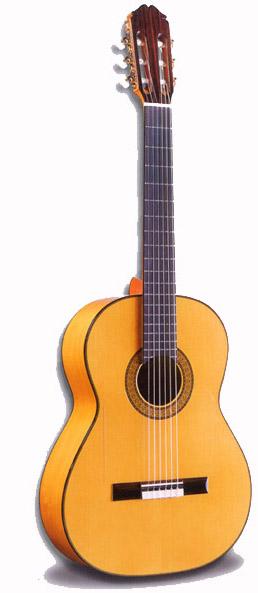


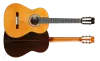
Guitarra flamenca de ciprés macizo y mango de cedro con refuerzo de ébano.


The tocaores use the techniques of alzapúa, picado, rasgueado and trémolo. The 'rasgueo' or strumming can be done using 5, 4 o 3 fingers, this last one was created by the master Sabicas. The use of hte thumbs is also very distinctive of the flamenco touch. The guitar players place the thumb in the harmonic lid and the index and middle fingers on the cords that are over the ones that are being played. This way the performer reaches a greater power and sonority than the classic guitarrist. Also the middle finger is placed in the pickguard to reach a better precission and strength when playing the cords. Besides, the use of the pickguard as a percussion element gives strength to the flamenco interpretation.


Some flamenco songs are interpreted without instruments, without guitar. Depending on the kind of performance its called in different ways:


  • Airy touch: lively, rythmic, cheerful, brilliant sonority, almost metallic.
  • Gipsy or flamenco touch: deep and with a pinch, uses preferably the bordones and musical setbacks
  • Pastueño: slow and relaxed
  • Sober touch: without ornaments or superflous brags
  • Virtuous: with exceptional technique domain, it can risk falling into excessive force 
  • Short touch: poor in technique and expressive resources 
  • Cold touch: lack of depth and pinch


Some important guitarrists have been Antonio de Torres Jurad, considered the guitar's father, Manuel Ramírez de Galarreta, el Gran Ramírez and its pupil Santos Hernández. He, at the same time, built several guitars for the Sabicas master, main promoter of the flamenco internalization. Others that stand out too are Domingo Esteso, Modesto Borreguero or the Conde brothers, Faustino y Julio, nieces of the first one. And, of course, it have to be mention the genius Paco de Lucía, considered one of the main modern flamenco figures, since he is credited with the origin of the reform of the musical scene thanks to the fussion of new rythms like jazz, bossa nova and classical music.
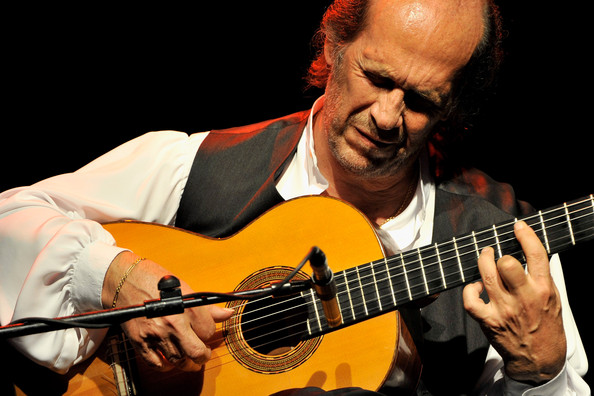
 

Paco de Lucía fue el precursor de las fusiones flamencas con otros estilos musicales.


Read more →
Mi única llave.The title of the new album featured by José Mercé

Mi única llave.The title of the new album featured by José Mercé

El álbum, considerado por la crítica como un disco impecable, y el más innovador en el flamenco
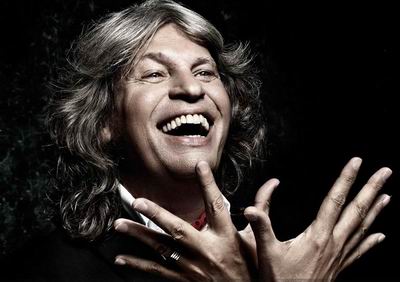
Jose Mercé       

Mi única llave. Is the title of the new album featured by José Mercé,produced by Javier Limón­­ and published on the date 16th October 2012.The singer songwriter says about the album: “Is a flamenco album, but knowing that we are in the 21th century. Serious , sober ,deep” says the singer born in 1955 in the in the flamenco neighbourhood called Santiago de Jerez de la Frontera. Mi única llave is a flamenco , impecable album with great musical richness and good guitar-players. This album is elaborated with few elements that covers all the sonic spectrum in a good work made by Javier who has achieved  to hold the album just with guitars, percussions, clappings and little more. This album has also collaborations with Eric Truffaz (Trumpeter),Allain Mallet (Piano) and Layth Al-Rubave (violinist) that provide to the album connexions with other kind of musics.


Mi única llave has a lot of surprises which enriches the album. “The best guitar-players of Spain are in the album: Diego del Morao, Pepe Habichuela, Tomatito y Manuel Parrilla” say José Mercé. Javier Limón adds “Alejandro Sanz has composed a bulería honoree to Moraíto Chico (who is José Mercé’s guitar-player died in 2011) the martinete that heads the album was recorded in Boston with fifteen girls’s chorus ; the  zambra’s Salvaora by Manolo Caracol version was recorded in a Masonic church from the XIX century with the jazz’s guitar player Alain Mallet; the French trumpeter Eric Truffaz plays with Pepe Habichuela in the Elegia to Ramón Sijé, poem by Miguel Hernández , reminding the Enrique Morente’s work, there also are some fandangos from Huelva with the collaboration of Layth Al-Rubave ,a incredible 19 years old jordanian violinist…Is the most gypsy and comtemporary album of José”

  Almost every songs are composed by Javier Limón and José Mercé. The first single is titled “La llave del amor”.The tangos are flamencos, energics, deeps. “The sound of this album sticks to our ear”say José Mercé who praise to Javier Limón  “We know each other from long time ago and we always wanted to make together an album and it just happened. His works make you feel very comfortable.I think we have made a good album, more stabilised than the previous albums”


Read more →
Niña Pastori is back with a new album "La orilla de mi pelo"

Niña Pastori is back with a new album "La orilla de mi pelo"

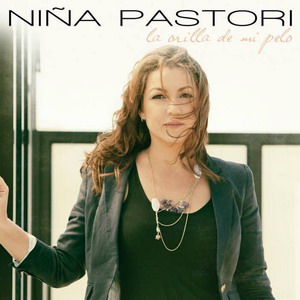
'La orilla de mi pelo' es el álbum para 2011 de Niña Pastori.
Niña Pastori
"La orilla de mi pelo" is the album of the year 2011 for Niña Pastori. A work with a pop dominance over the flamenco. The first single is the title of the album. The song begins with the chorus, with the voice of Niña Pastori, a very flamenco choir and a bright rhythm, somthing new for the artist from San Fernando, before that she built her songs with a flamenco guitare, now she is doing it with an acoustic and electrical guitare. The video clio of the song has been shooted in New York and directed by Ruben Martin.Producted by Chboli, the direction of the single "La orilla de mi pelo" is also marked by the musicians. For the drums Nathaniel Townsley, who played with Alejandro Sanz, Joe Zawinul, RIchard Bona, Mariah Carey, Public Enemy amd Stevie Wonder, among others. For the electrical and acoustic guitaresJan Emil Ozveren, who worked with Alejandro Sanz but also with Alicia Keys, Corine Bailey Rae or Roisin Murphy. Townsley and Ozveren play for the first time with the Niña Pastori and the other musicians are Spanish, the usual musicians like Alfonso Perez (piano and keyboards) and Antonio Ramos "Maca" (bass).
Read more →
"De Noche", the new album of Antonio Carmona.

"De Noche", the new album of Antonio Carmona.

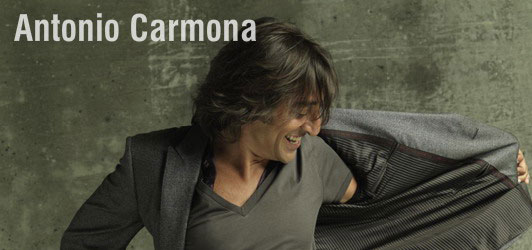
A finales de mayo se publicará "De noche" de Antonio Carmona en solitario.
At the end of May will be published "De noche", the second disc in solo. Antonio Carmona is back next May 31 with "De noche", and he's introducing this new album with the single "Camino de los sueños" with Nelly Furtado. A duet with Nelly Furtado, one of the main international artist of the moment, with a song in English and Spanish, set and produced with Julio Reyes Copello.
Read more →
Flamenco Export Help
Order status Customer Service

(+34) 91 542 72 51.
We’re open from Monday – Friday 10h-13:30h / 17:00-20:00h and Saturdays 10h-13:30h (GMT + 1).

 
In 2024, we will be closed for holidays on the 1st and 6th January, 28th, 29th, and 30th March, 1st, 2nd, and 15th May, 25th July, 15th August, 12th October, 1st and 9th November, 6th, 7th, and 25th December.
 
Our shop is located in Calle Campomanes nº 4, Madrid 28013 España (Ópera Metro Station)