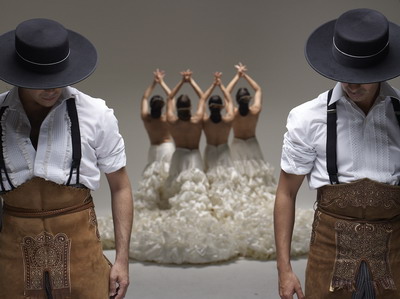
The New Spanish Ballet is exploring the magic of the flamenco universe in "Cambio de tercio": XV. Festival of Jerez
|





















 Wholesalers/Stockists
 Contact


|
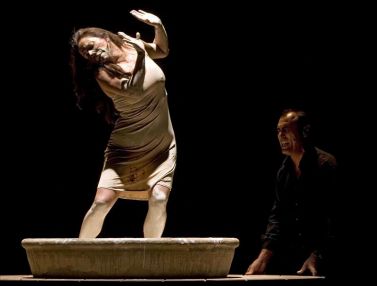
In this show, the memories, real and fictitious ones, are again the "leit motiv"of a play in which the symbolisim of a potter's wheel focus a scene, where Yerbabuena shows up ready to mold those sleepy conciences starting from her reputation of"melancolic woman". The last day of the "muestra jerezana"of flamenco and spanish dance is completed with the session , from noon, of the workshop, "Understand the flamenco".Learn to distinguish the "palos", taught by Faustino Núñez in the Andaluz Center of Flamenco (CAF); and with a new exhibition from 7pm in the Sala Paúl, of the workshop of choreography of the valencian "maestro"Javier Latorre. In "When I was...", Eva Yerbabuena gets back that melancolic and nostalgic air that characterizes her, under the influence of the victims's relatives loss, in the Spanish Civil War, to think again about the absences, the movement and the search. "I am a person always searching through movement, I can talk more with movement than with words. "What happened?, why this happened?, What would have happened if everthing would have been different?", thinks Yerbabuena in the short sypnosis of a play that locks up, as in other creations, more questions than answers. For this work, the Granadine dancer and choreographer has come back with her habitual team, with the guitarist Paco Jarana. From his notes start the score of the show, with the scenic management of Juan Ruesga. In "the Alfarero worshop", one of the most important scenes of this production, and with the mud as guide of the plot, that' s where the director admits that Eva "spreads all her mystery", in a conceived play,he explains, "like a circle structure, where the dancer and the lump of mud spinning form an important visual parallelism". |

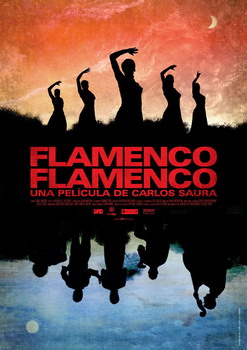
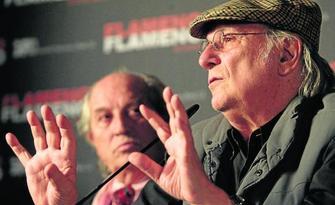
The director will launch the 11 of november in Sevilla in the framework of the European Cinema Festival, and duringa special gala, his last work "Flamenco, Flamenco". With this movie, filmed in Sevilla, Saura wants to "show the evolutionof ths songs, dances and musics of this art". The festival of Sevilla will be celebrated from the 5 to the 13 of november"."Flamenco, Flamenco" as the best presentation of the personal and special way to make music movie developped by Carlos Saura and that allowed to the spectators all over the world to enjoy our cinema and our art.The movie is not based on a fiction story because according to Saura "insert something else than the beauty of the musicand of the dance in front of the camera is a treason to the purity of this art". There are two narrative elements, avital travel and the light, that are used as a support to the music act and that allow a subliminal communication withthe spectator. |
Appreciation and prizes in movie competitions all around the world- from Berlin to Cannes, from New York to San Sebastian- pull the career of Carlos Saura (Huesca 1932). However, it is in the Montreal festival, in Canada, where the author of famous titles of musical cinema as Bodas de sangre or Sevillanas, received a lot of prizes, close to a ten for movies like El amor brujo, Carmen, Pajarico, Goya en Burdeos or El séptimo día for which he received, in the edition of 2004, the prize of the best director, like the Gran Premio Especial de las Amercias in 1995 for the movie Flamenco. |
(+34) 91 542 72 51.
We’re open from Monday – Friday 10h-13:30h / 17:00-20:00h and Saturdays 10h-13:30h (GMT + 1).
In 2024, we will be closed for holidays on the 1st and 6th January, 28th, 29th, and 30th March, 1st, 2nd, and 15th May, 25th July, 15th August, 12th October, 1st and 9th November, 6th, 7th, and 25th December.
Our shop is located in Calle Campomanes nº 4, Madrid 28013 España (Ópera Metro Station)