




Search
We export flamenco to all countries in the world.
WORLDWIDE SHIPPING
Shopping Cart
Tips for la Feria de Córdoba

Tips for la Feria de Córdoba

The next important event in the fiestas calendar is la Feria de Córdoba, which will start this saturday 20th of may and will last until the next saturday, the 27th. As in la Feria de Abril of Sevilla, the inauguration of the celebrations will start with the lightning of the main entrance and the stalls, and also the fireworks. This will happen the 20th at midnight. This year the entrance has been designed with a central squared body of 13,5 metres from which 12 columns with capitals emerge. Over them there will be a scale replica of the Mosque Cathedral, and the construction will be completed with two big doors on the sides as well as several arcs that will create a 6 metres wide porch. Also the entrance will be lightened by 55.000 lámparas de LED. 


On the other side, this year the compound will have 98 stalls and all of them will include a kitchen where they would cook the typical tapas and dishes of the fiesta, and they will also have a permit to open until from 13.00 pm to 1.00 am. Also, the 22nd and 23th of may the Best Stalls of the Feria contest will take place. In it, it will be chosen the stall with the best entrance, the best stall in general and the best one with a decorated backyard.


In relation to the access of the feria, a parking area has been set up on the right side of the Andalucia highway. A total of 69.322 squared metres of land intended for a maximum of 3.200 cars. And for two-wheeled vehicles an area for secure parking has been enabled in the auxiliary route of the street Compositor Rafael Castro. And with respect of the public transport, there would be 12 additional lines to help the access to the event from the different city neighborhoods. Inside the facilities, also, there will be a pneumatic train that will tour through the inside streets of the feria. It'll start on the entrance and will pass by the Guadalquivir street, the Municipal Stall and the main street until getting back to the start point.


Of course, the feria will also have horse rides and carriages from 1.00 till 8.00 pm. During this hours, several pedestrian crossings have been foreseen and the horse rides will have to be run in one direction only and they will only be allowed to pass through the crossing streets. The 20th, also, there will be a Traditional Carriages Exhibition. On the other hand, different events like bullfights and musical concerts will happen during the feria and famous spanish singers like Diego El Cigala, the Aslándticos, David de María, Manu Tenorio, la Década Prodigiosa, los Chunguitos and los Coros Rocieros of the XXII Encuentro Rociero Camino del Arenal will be part of the fiesta. All of this has been organized expecting to entertain the public and offer a variety of different activities for all ages.


Regarding the dressing code, even though la Feria de Abril its still recent, its never bad to remember some useful ideas that can make your life much easier, specially if your are thinking to assist and its your first time:


  • Leave the sunglasses at home: Yes, they are a great tool to protect yourself from the sun, but, as a matter of fact, the sun is something that you are not gonna be able to avoid no matter when you go. And since you are gonna be eating, dancing, walking around, and having fun all day the shades can become an annoying tool to keep with you, specially if you do not want to loose them. Also they don't look very good with the traditional flamenca look.
  • Never use the shawl hanging from the hip: You can put it the traditional way over the shoulders, crossed or following the lines of your dress necklines, but never hang them on the hip, it doesn't look good.


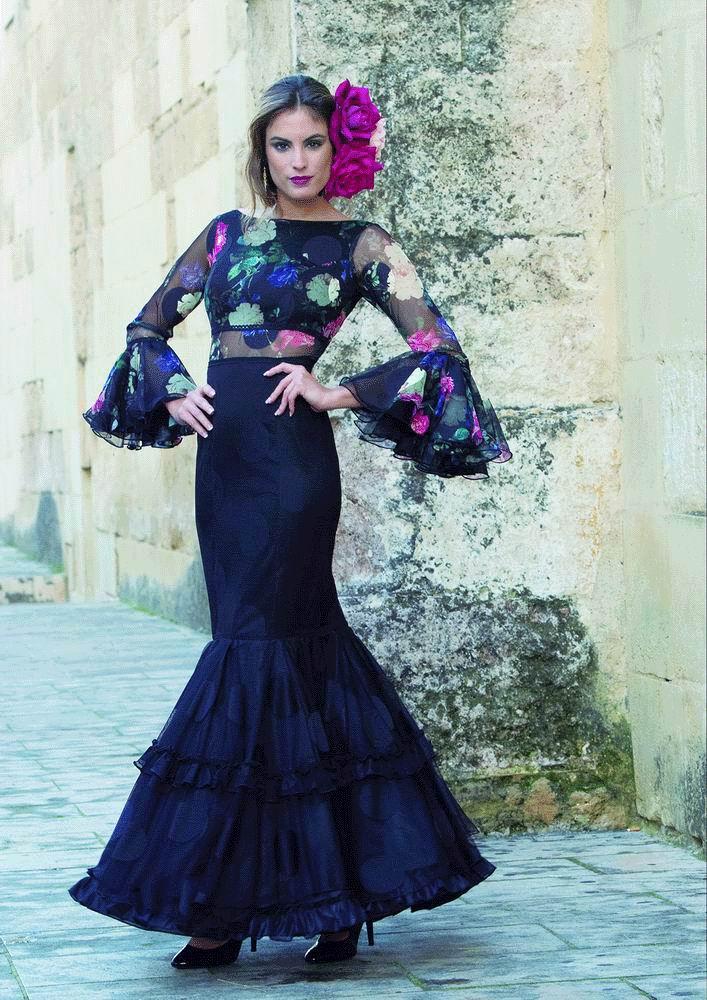
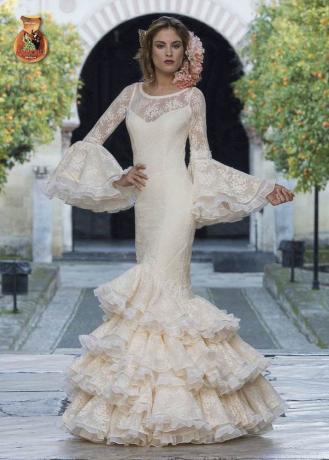
Flamenca dress collection 2017-2018 de Mari Cruz, model Madruga


  • Hold your shawl: When you put it over you, even if its in the right way, make sure to use safety pins and even a big elegant clasp. The last thing we want is for it to move or even fall. 
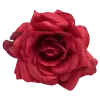
  • Use the flowers on your favor: the hair flowers are accesories that always give a colour touch and happiness to the look. However, one unique flower put over your ear is a very guiri idea, even more if its used with the hair down. The advisable thing to do is to use a bun or pull the hair back and combine different flowers. Nowadays there are infinite possibilites so use them. Some options in that sense are the following: put the flowers in the classic way, on top of the head; or combine different sizes of them all over the hair to give it a modern touch. You can also use the flowers as a crown over symmetric hairdos and on the side of the head with asymmetric ones. If you use ponytails or braids you can also use different flowers of the same size on both sides of the head, or just simply put the flower over a low bun. 


In regards of the kind of flower to use, you can choose whatever you like, carnations, jasmines, roses, etc. The idea is to be original.  

Flamenca flowers with a big peony in purple and salmon tones


  • Be careful with the footwear: Don't use flat sandals or flip flos to to go with a flamenca dress. Use a shoe with heels of at least 4 o 5 cm, you can also choose heel wedges so its more comfortable to walk. This are an option pretty popular and useful, since they offer height but don't loose comfortability. Besides you can use then as peep toes if you want something more fresh. If you decide to use sandals they should have a little bit of heel, they will give the dress a more sophisticated air E incluso los zapatos de salón clasicos cerrados son una buena opción para darle un toque elegante. Y en cuanto a colores y decoración, hoy en día los hay de muchos tipos, puedes utilizarlos de un solo color base o con lunares, de charol o de otro tipo de materiales. Elige aquellos que mejor vayan con tu outfit.
  • Use the pockets: A lot of the dresses include a hidden pocket in between the fringes. Use it. And try to reduce as much as possible the amount of things you are gonna take with you, mobile phone, money, keys, etc. It will ease your mind.
  • Flamenca dresses inspiration: you can get inspiration from the most modern tendencies, but don't forget that in the end what matters is that the dress is comfortable and handy. Keep in mind that you are gonna be out a lot of hours eating, dancing, walking, and if you need to retouch the dress constantly you are gonna end up fed up.


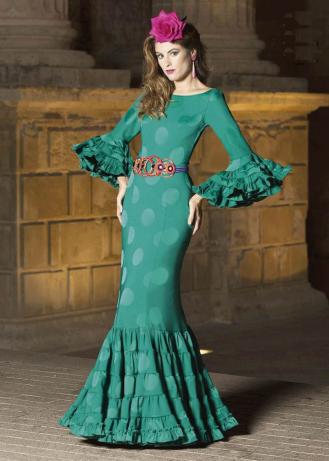
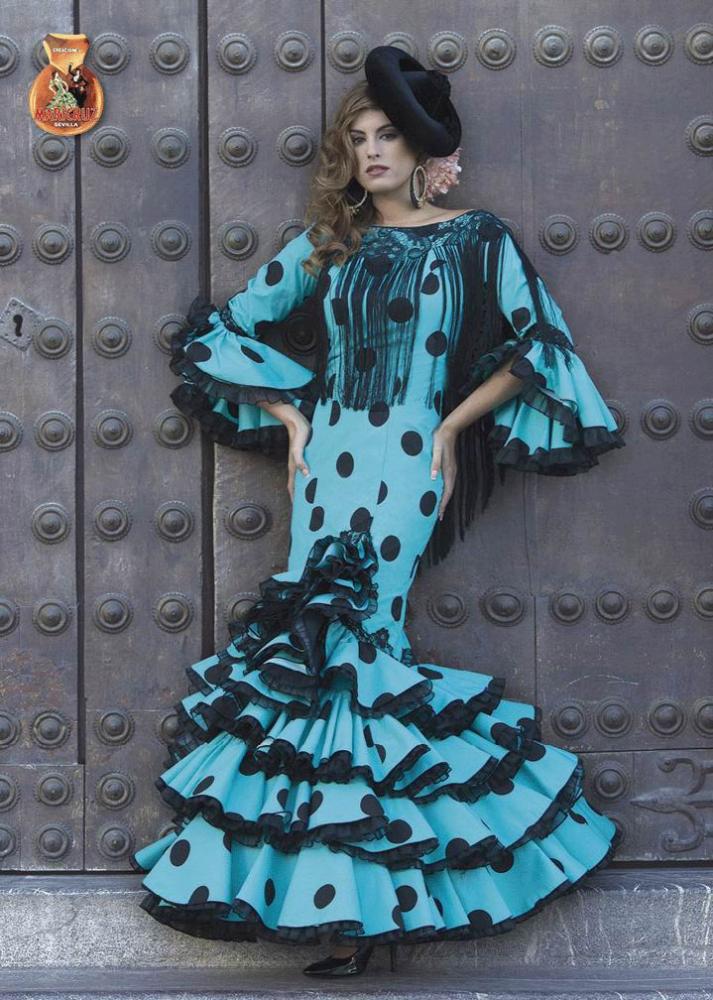
Flamenca dress collection 2017-2018 model Zambra


  • If its cool: Avoid as much as possible to use coats, blazers or leather jackets. Find other options that are more delicate like pashminas or thick shawls, they will keep you warm and it will not be seen as though you are disguised. 
  • If you have company: It is not neccesary but if you go with someone, you partner should take care of their attire too.

Read more →
Variedad de escotes para trajes de flamenca

Variedad de escotes para trajes de flamenca

Here it is a basic list of the types of necklines that you can find in our selection of flamenca dresses in Flamencoexport. In order to find the one that would suit you the best, you would need, in the first place, to have your body type in mind and also your personal taste. However, all of them are beautiful with great quality, and can be perfectly combined with all sorts of accesories to make them brighter, more cheerful and elegant.


1. V-NECK


Classic design in v-neck. It can be combined for example with a shawl over the back and shoulders in different positions. 


Flamenca dress Madruga Model, 2017-2018 collection.


2. ROUNDED NECKLINE


Traditional rounded neckline dresses.


Flamenca dress Eva Negro Model, 2017-2018 collection.


3. SQUARED NECKLINE


Angular neckline that offers a different touch to the typical flamenca dress.


Flamenca dress Petalo Model, 2017-2018 collection.


2. HIGH NECKLINE


A dress with a closed neckline can be matched with frills, polka dots designs or any other decorations to compensate the seriousness of the suit.


Flamenca dress Night Model, 2017-2018 collection.


3. HEART SHAPED NECKLINE


It is very flattering for everyone since it is notched at the chest area.


Flamenca dress Elvira Model, 2017-2018 collection.


4. SEE THROUGH HIGH NECKLINE 


See through high neckline. Flattering, classic with a modern touch.


 Flamenca dress Luz Model, 2017-2018 collection.


5. SHARP V-NECK


For those who like to be daring, this kinds of dresses have a sharp v-neck that gives the person a sexy touch.


Flamenca dress Jardin Model, 2017-2018 collection.


7. SLEVEELESS NECKLINE


Rounded sleeveless neckline for those hot days or for events like Feria de Abril were people dance, eat and enjoy all day.


Flamenca dress Clara Model, 2017-2018 collection.


6. HALTER


Daring type of neckline, since this kind of dress leaves the back exposed.


Flamenca dress Canastera Model, 2017-2018 collection.


Read more →
Dresses and skirts, a booming industry

Dresses and skirts, a booming industry

The regional costumes or flamenca dresses are clothes in constant evolution. The origin of this attire goes back to the late 19th, early 20th century, but since then it has suffered big changes according to the era and the social situation of each moment in time. 


Flamenca dress Dalia model of the 2017-2018 collection from Creaciones Mari Cruz.


The flamenca dress combines tradition and innovation, keeps a basic tailored structure of the body on the hip, and a skirt with frills. However, over time the designer's creativity has flowed and a lot of elements have eventually changed. From the idea of combining colours and designs, to alterations in elements like necklines, sleeves and the use of different materials to make them. Since the 90's, after a decade of over the top dresses with a lot of laces and satin ribbons, they became simpler, without too many ornaments, starch, and hidden hips. Silk cloths, plain colours and polka dots slowly became more used in the new designs. Also, the contour waist and the frills became more popular, and with the arrival of the 21st century they started rescuing materials like poplin, a thin, rigid, heavy and durable cloth that has a fine grooved horizontal look. The dresses, also, began to be manufactured in two pieces and decorated with bigger polka dots.


According to the International Flamenco Fashion Fair, the flamenca dress sector moves more than 120 million euros annually only in exports, with Japan being the country thar receives the most goods. About 65.000 people visited the fair last month, which celebrated 23 years of activity, and in the event 46 designers displayed 1.400 dresses in 32 professional runways. Despite the decrease of the industry during the economical crisis, the flamenco fashion is still weathering the storm well. Specially since, even though there are high quality dresses or designer ones with high prices, it also exists a great variety of them for people who wants something less expensive. The average prices of this costumes are in between 300 or 400 euros and 2000, depending of their quality and exclusivity.


The haute couture industry has also started making space for this products, and highly reknowned designers like Yves Saint Laurent and Victorio & Lucchino have already started their own flamenca dresses clothing line. Also, they have extended this business to the stage and the artists where a lot of unique costumes have been manufactured exclusively for various flamenco dancers. In both environments the main key has always been to mix classic with modern ideas.


On the other hand, the flamenco skirts are a complementary element of this fashion area that also has changed a little bit with time. The most important thing when choosing a skirt for dance is that it has to be comfortable, has to have flight so it can be easily handled, and it has to fit well the person that is using it. Skirts are key for dance academies and schools, and also for all sorts of amateur and professional shows. There are two kinds of basic dancing skirts: the rehearsal and the show ones.


Rehearsal skirt to dance flamenco Rocío model.


The rehearsal skirt tends to be shorter than the one made for stage, and this is because it helps the teacher to watch the students feet while they practice in class. That way, it is easier to correct the mistakes and even the students can look at themselves and know what they are doing wrong. On the other side, the professional skirt is for flamenco dancers who use it for their shows on stage.


As for the skirts main characteristics, the flare will depend on the amount of cloth used to manufacture it as well as the number of keels. The keels are essentially the vertical seams that connect the different parts of the garment. The more keels it includes the more flare the skirt will have. Often this costumes have frills as decorative elements, but there are also those that don't have them. In order for it to fit the dancers figure it is important that the skirt has a lot of flare, and this is achieved with the cloth, godets and frills. Godets are cut fabric pleats added to the lower part of the skirt to give it more flight and weight. Also it is interesting to mention that some models use yoke, which is a superior piece of cloth that adjusts to the hip, from which the skirt part begins. 


Even though it is known by everyone, nowadays exists a variety of skirts with different designs, colours, prints and sizes. As and advice, in order to choose a skirt it is better to not select one that uses two plain colours, because the frills can look like they are patches. Instead look for skirts with one colour and polka dots, it will look much better. However, the decision about which one you should choose will depend on your body type as well as the amount and level of activity you are doing. There are skirts for amateurs, semi professionals or professionals. If you are just starting in the flamenco dance you don't really need to spend too much money on a skirt, though the more you dance you will probably look for a better quality one. As in choosing the correct shoes, beyond the design, the most important thing is that your garment is comfortable. In Flamencoexport also, if you want, you can customize them according to your measurments and your personal taste. The biggest advantage of this is that it will we taylor made and it will fit you perfectly. Besides it will be original. 


The most common skirts are normally manufactured in flat-knitted fabric, since it is a material that doesn't get damaged as fast, its light and has a lot of flare. The waist is usually elastic, which allows it to fit the body of the dancer, and, depending of the model, some can even come without zipper or brackets. This basically makes much easier to get it fix if needed. It is important, of course, to take good care of the skirts. It has to be appropiately washed and stored. Try not to fold it to not wrinkle it, and if possible, hang it so it doesn't get deformed. 


Read more →
Best tips to survive the Feria de Abril

Best tips to survive the Feria de Abril

1. Meet some local people

If you meet somebody from the area, not only you will have a local guide but also a host that would help you get inside the private booths, which are the real essence of the fiesta. However, if it is not the case and you don't know anyone, you can also visit any of the 16 public stalls located inside the fair. They all have free entry and, even though the environment inside them is not as authentic, you can still have fun and enjoy the party.


2. The fair starts with a fried fish dinner and the lighting of the entrance

Don't miss any of this two moments. In the spectacular entrance lighting they are used 250.000 light bulbs and it is done at 12.00 at night. Also, this day is called the Fried Fish Monday, because afterwards it is traditional to eat fried fish cooked in the typical andalusian way.


3. Most important days of the fair

The most important days of la Feria de Abril are Tuesday to Thursday. On the weekend a lot of locals travel to the nearest coast to rest and let the foreigners to enjoy their fiesta as well. 


4. Dress formally

If it is the first time you go to the event and you don't have a flamenca dress or suit, don't worry. Dress elegant and use accesories like flowers on the hair, shawls, fans, etc, to give yourself a special touch. Never dress casual. The locals are very serious about their fair and the way you dress up its very important. 


5. El Rebujito

This is the most typical drink of the fair. It is made with a mix of fino sherry and either 7Up or Sprite. It actually is very refreshing and its good to cool yourself down, but be careful because you can end up really drunk very fast, since its an easy beverage to have.


6. Fireworks

One of the biggest moments of the fair are the fireworkds to close the fiesta on the last day. If you want to watch properly the fireworks castle go to el Muelle de las Delicias, that is the best place for it.


7. Enjoy the days...

For a first time visit, we recommend you to go to the fair during the day and sometime in the middle of the week. You'll enjoy the locals show, their arrivals to the fair riding a horse or in a horse carriage and dressed with the traditional costumes. Also you can see the art of Sevilla and how they dance and party.


8. And nights

After 8.00 pm the fair transforms itself. The drinks start flowing, people claps to the sound of the loud music, the compound is illuminated with thousands of light bulbs and young adults start their personal party.


9. Find a good place to meet

Everybody tends to meet always in the entrance, hence why it always becomes really difficult to find anyone. Choose a different place to meet with friends, like, for example, the door of a specific booth.  


10. Learn to dance sevillanas

If you want to inmerse yourself into the actual environment of the fair, learn to dance sevillanas and share some dances with the locals. 


11. Find a map

It is actually a really big compound full of booths and streets that are very similar. Find a map of the place, you'll need it to know where you are at all times. 


12. Wear comfortable shoes that you do not mind messing with

The floor is covered of albero, a special orange sand that is really effective when it rains but gets your shoes really dirty. Besides, you are gonna walk and dance a lot, so always use comfortable shoes. 


13. Gastronomy

Don't forget to try the andalusian gastronomy, it is incredibly rich. And, of course, taste the rebujito, that will also help you to get your food down. 


14. Public transport

The fair has a pretty big parking space but it is never enough, there is always a lot of people that wants to have a place. Use the public transport, you will thank it later. This year, however, be aware because it has been said that there is a possibility of a metro strike during those days. Keep that in mind when choosing how to go to the fair. 


15. The things from Hell

That is how the fair rides are called. It is related to the fact that apparently they create such a big amount of noise it always seems like Hell. In fact, that's how the area where the attractions are located its commonly known. Anyway, enjoy the party and the fun rides. 


16. Fritters and churros with chocolate

At dawn visit the gypsies booths to try the fritters and hot churros with chocolate. There is not better way to recover from a night of partying.


17. Be careful with pickpockets

It is common sense, but it never hurts to remember that in every place where a lot of people congregates its easier for pickpockets to try and steal things. Watch your stuff at all times and never take out valuable items.


Read more →
Shawls and combs, perfect accesories

Shawls and combs, perfect accesories

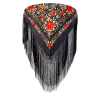
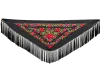
The manila shawls are square silk cloths decorated normally with vibrant colours with flowers, birds, etc, and finished with an exterior border with fringes. Its origins go back to the trade routes created by the spanish Empire with the asiatic continent, more specifically with China and Filipinas. It is from there where the shipments of oriental merchandise used to come, in between those things there were the shawls. Its popularity increased in Spain initially due to the prohibition of the Catholic Monarchs in 1492 of the use of veils. Moor women started, then, to use this oriental shawls to cover their heads and faces. 


Originally they were made in large sizes and in silk, and the decorations used to reflect the oriental flora and fauna with chrysanthemums, bamboos, dragons and birds originals from those lands. Over time and with the increment in the spanish demand they started to modify the shawls changing the embroidery with roses and carnations, and in Spain they introduced the fringes, original from the arab culture. This fringes were placed with silk thread and using the macrame and crochet techniques. The typical colours used to be black, white, ivory and red. The manufacture process started with the creation of a paper template in which there were made several perforations. Then, this template was used to create the marks with chalk over the cloth, and afterwards, with the help of a racket, the cloth was carefully embroidered. The work was finished with the placement of the fringes. In order for the shawls to arrive in the best possible condition to their destiny, special cases were manufactured in Filipinas to transport them. Squared boxes with lacqued and golden wood, decorated with mother-of-pearl inlays and chinese decorative motives
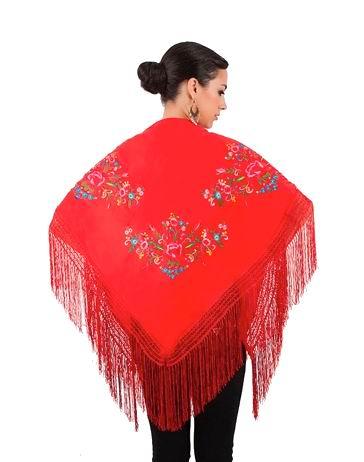


As for the right way of using them, the most common is on top of the shoulders, but also tied on the side or at the height of the hips. And for the proper way of storage them there is an expert way of folding it, though for most people who doesn't know how to do it, it is recommended to hang them in the wardrobe with a plastic cover over it. In case it is needed you can flip it over and gently go over it with the steam iron.

 
Regarding the types of manila shawls that exist, there are two traditional kinds that can be mentioned. On one hand there are the cigarreros (inmortalized in the Carmen de Bizet opera), decorated with big roses and carnations, embroidered in vibrant colours, with bamboo branches and flowers. On the other hand, there are the isabelinos, whose borders are decorated with flowers but the center part is empty. Each of the flowers that used to decorate the shawl had a special meaning: the violets were related to purity, the daisies to impatience, the roses to secrets and the sunflowers to loyalty. 


This way, little by little they became more and more popular until they ended up replacing classic shawls and headscarves in the XIX century. And over time a lot of new workshops began to appear in Sevilla to create their own collections. Also, the flamenco dancers borrowed the idea and integrated it into the dancing. Its use, however, was really complicated due to the fact that only the most expert dancers were able to use them in their dances as if the shawls were an extension of their bodies. 


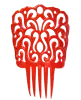
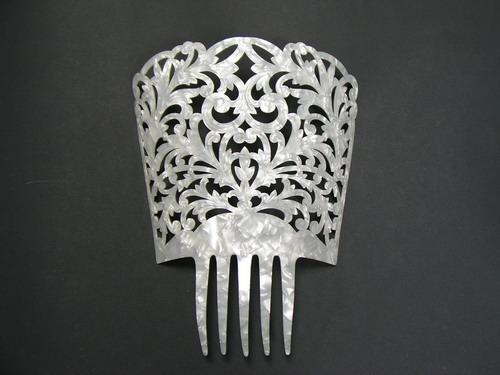
The combs, on the other hand, were feminine ornaments for the hair with a convex body and a group of spikes that fit in the bun. Originally they were manufactured with tortoiseshell, but this days they are mostly made out of synthetic materials. They became traditional in Spain at the end of the XVIII century, and the shawl is often a classic complement for it, since it stylizes women's figure. 


IMPORTANT:

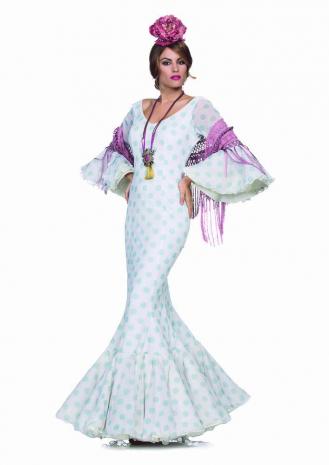
If you are interested in buying any shawls or combs, you can visit our website were we have a huge selection in different colours, styles, etc. This are the best accesories for your flamenca dresses or to acompany your dances on stage. 


Read more →
Flamenco Export Help
Order status Customer Service

(+34) 91 542 72 51.
We’re open from Monday – Friday 10h-13:30h / 17:00-20:00h and Saturdays 10h-13:30h (GMT + 1).

 
In 2024, we will be closed for holidays on the 1st and 6th January, 28th, 29th, and 30th March, 1st, 2nd, and 15th May, 25th July, 15th August, 12th October, 1st and 9th November, 6th, 7th, and 25th December.
 
Our shop is located in Calle Campomanes nº 4, Madrid 28013 España (Ópera Metro Station)