Ternary meter signature
The time signature (also known as "meter signature") is a notational convention used in Western musical notation to specify how many beats are in each measure and what note value constitutes one beat. In the beat 3/4. Each meter has three beats.
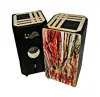
Tumbaora, Conga
The conga or tumbadora is a tall, narrow, single-headed Cuban drum with African antecedents. It is thought to be derived from the Makuta drums or similar drums associated with Afro-Cubans of Central African descent. A person who plays conga is called a "conguero". Although ultimately derived from African drums made from hollowed logs, the Cuban conga is staved, like a barrel. These drums were probably made from salvaged barrels originally. They are used both in Afro-Caribbean religious music and as the principal instrument in Rumba. Congas are now very common in Latin music, including salsa music, merengue music, Reggaeton, as well as many other forms of American popular music.
Most modern congas have a staved wooden or fiberglass shell, and a screw-tensioned drumhead. They are usually played in sets of two to four with the fingers and palms of the hand. Typical congas stand approximately 75 cm from the bottom of the shell to the head. The drums may be played while seated. Alternatively, the drums may be mounted on a rack or stand to permit the player to play while standing.
Tablao flamenco
Place with flamenco shows. They developped during the XX. Century all around Spain to replace the Café Cantantes.
Tango/ Tango Flamenco
A flamenco palo with stanza (copla), with three or four octosyllable verses. One of the basic flamenco styles, with several modes; among others we emphasize on the ones from Cadiz, Triana, Jerez and Malaga. All the theories indicate that the origin of tango is between Cadiz and Sevilla. Nothing to do with the tango from Argentina. Possibly coming from some old songs (XIX. Century). First singers were El Mellizo and Aurelio Sellés in Cadiz, Pastora Pavón and el Titi in Sevilla, Frijones and el Mojama in Jerez, and La Pirula, la Repompa and el Piyayo in Málaga.
Tango Gitano, Gypsy Tango
Perfromed by a bailaora, the other ones "jalean" with shouts, flattering comments and palmask (hand clapping).
Tarantas
Tarantas is a style of flamenco from Almería, derived from the Andalusian fandango.
Tarantas, they belong to the Andalusian songs branch, folk songs from the East coast, flamenco styles originated in the eastern provinces, Almeria and Murcia, songs from the mine, and free measure. They belong to the tangos group with a binary measure. The taranta is the major song of the eastern style. Long song, hard, rough and manly, only influenced by the fandango. The taranta is the mine song par excellence. Born in the miner basins the taranta is the reflect of the tortured landscapes and transmit the superhuman efforts and the tiredness of the first countrymen.
Very romantic folk song and very expressive. The guitar is the tone support and keeps the rhythm.
Taranto
Tarantos, they belong to the Andalusian folk songs.
Tembleque
Used with heels and without moving of the place.
Templar la voz
The cantaor warms up his voice, and consolidated the tonality and the tempo (marked by the guitar).
Temple
Section of the singing useful for the singer to find the right tone, the guitar helps him.
Temporera
Flamenco song from the countryside.
Tercio
Each one of the lyrics of some songs. Melodic verses. For example, for teh Solea, the first tercio is the first lyric and in a Malagueña the first tercio is the first melodic verse.
Tientos
Tiento is a musical genre and flamenco palo originating in Spain in the mid-15th century. It is formally analogous to the fantasia (fantasy), found in England, Germany, and the Low Countries, and also the ricercare, first found in Italy. The word derives from the Spanish verb tentar (meaning either to touch, to tempt or to attempt), and was originally applied to music for various instruments. By the end of the 16th century the tiento was exclusively a keyboard form, especially of organ music. It continued to be the predominant form in the Spanish organ tradition through the time of Cabanilles, and developed many variants. Additionally, many 20th century composers have written works entitled "tiento."
Toque
Act and effect of playing the flamenco guitar.
Toque airoso
A lively and rhythmical play, with a brilliant sonority (almost metallic).
Toque corto
Poor in technical and expressive resources.
Toque gitano/gypsy or flamenco
The deep and pure manner to play, using "bordones" and backbeat.
Toque pastueño
A calm way to play, performed very slowly.
Toque virtuoso
Exceptional control of the technic. The technis has to serve the expression. Not with too much ornaments.
Tremolo
Tremolo, or tremolando, is a musical term describing various trembling effects, falling roughly into two types.
Triana
Triana is a neighborhood in the city of Seville, Spain, across the river Guadalquivir from the center, and in fact the majority, of the city. Triana shares what is effectively an island (sitting between two arms of the Guadalquivir except for a narrow strip to the north where it is canalized under the ground) with Los Remedios to the south and La Cartuja to the north. The island is also named Isla de la Cartuja, and has been home to human settlement since before the Romans colonized Hispalis (Seville).
Traditionally, residents of Triana consider the neighborhood to be an entity separate from the rest of Seville, as a result of its popular sense of identity. In reality, Triana forms an integral part of Seville, its culture, and its tradition.
Triana has traditionally housed a large population of Gitanos (Roma), usually living in the old corral style communal homes. This image of Triana, however, is no longer accurate. Calle Betis, for example, is home to some of the most expensive real estate in the province, and indeed in the region as a whole, and much of the neighborhood is considerably well-to-do.
Trilleras
Flamenco song from Andalusia, usually sung during the rural work. Also called songs from Trilla.





























 Wholesalers/Stockists
 Contact


