Seguidilla sevillana
Seguidilla sevillana, belongs to the ternary metrical system group.
Sevillana
Sevillana, belongs to the ternary metrical system group.
Saeta
The "saeta" belongs to the songs without guitar, to the free styles group. It is a religious song, generally improvised and without any accompaniment, performed during the processions of the Holy Week (Easter) and with its origin in the Andalusian folklor. The text is made up various octosyllable verses and always had a religious meaning refering to actions and persons from the Passion. We sing in hounour of holy chracters.
The original "saeta" from Arcos de la Frontera, was accompanied by rudimentary wind instruments, generally manufactured by the own singer. A flat song..
Soleá por bulerías
Soleá por bulerías, it belongs to the solea group, metrical system of 12 times.
Seguiriyas
Seguiriyas, they belong to the seguirya group, 12 times metrical system.
Serrana
Serrana, it belongs to the seguirya group, 12 times metrical system.
Soleá por bulerías
Soleá por bulerías, it belongs to the solea group, metrical system of 12 times.
Seguiriyas
Seguiriyas, they belong to the seguirya group, 12 times metrical system.
Serrana
Serrana, it belongs to the seguirya group, 12 times metrical system.
Soleares
"Soleares", it belongs to the gypsy singing branch and it is included in the "soleares" family, it is a foundation singing.
"Alegrias", it belongs to the gypsy singing branch and it is included in the "soleares/solea" family, dancing singings, metric style of 12 times. It is a festive flamenco singing included in the group of Songs from Cadiz (called "Cantiñas"). Its "copla" or verse usually has four octosyllable verses. Its melody incites to dance. Its rhythm is determined by the metric of the "solea" compas, but it is different of the solea because of its time is faster. It is a light, happy and sensual style, clearly a dancing ryhthm.
Seguirya
"Seguirya", it belongs to the gypsy singing branch and it is included in the "seguirya" family, a foundation singing, metric style of 12 times. At the beginning we called that style "playera". It is a flamenco "palo", tragic song, deep, dark and devastating, interpreted slowly. On of the most importants flamenco "palos". The lyrics of its "coplas" are tragic and reflect the pain in the human relationships, love and death. Composed by four verses, six syllables in the first, second and fourth, and eleven in the third. The second and the fourth rhyme in consonant or assonant. The structure is not strict, the most important element is the feeling not the shape and you can find Seguiriyas with another metric (7-7-11-7 and 8-5-11-6). Another shape can be 6-11-6, the first and the third rhyme and we repeat the second one.
Serranas
"Seguirya", it belongs to the gypsy singing branch and it is included in the "seguirya" family, metric style of 12 times. The "Serrana" is a rural singing existing everywhere in Andalusia. It always lived in the vineyards of Jerez. After a time the "serrana" crossed the country and arrived in the cities.
Sevillanas
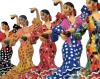
Sevillanas, they belong to the folkloric branch, songs to dance, they belong to the group of ternary measures. The Sevillana is the typical song and dance played during the different "ferias" that we celebrate all accross the Andalusian region, above all during the procession of "El Rocio", in the village of Almonteña de Huelva, or during the April Feria in Sevilla or the Andalusian ferias. They also are popular in the different processions and in the old times the Sevillanas were also present in the "Corralas" of neighbours and patios.
Its origin could be in the previous years to the Catholics Kings period. We have found some compositions under the name "Seguidillas castllanas". Then with the passage of time they become more "flamenco" and we begin to dance in the XVIII. Century until we get the songs and dances that we know today. The sevillanas are included in the flamenco "palos".
The Sevillanas appeared during the Feria of Sevilla in its first celebration, but we legally admitted them under that name in 1884. During this year the "Real Academia Española de la lengua" included that world in the dictionnary.
This is the most popular dance of Spain, you have some fast ones and other slow one.
We usually dance sevillanas in couple, but they are some exceptions and sometimes you can see a group (more tham 2 persons) dancing the four "coplas" of the sevillanas. Before they were seven "coplas" to compose a complete sevillana. We can differentiate four movements in this dance: paseíllos, pasadas, careos and remate. At the end of the last "copla" music and dance match up. It ia a romantic and provocative stance of defiance.
With a compas of 3 x 4, three times. The first one is strong and the two thers are weak.
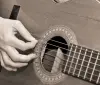
The first sounds are performed by "rasgueo" until the singer or the guitarist introduce the song.
The guitar is usually accompanied by "palmas" to accompany the singer or the group.
Soleares
Soleares, they belong to the fundamental songs.
Seguirya
Seguirya, it belongs to the fundamental songs, to the seguiriya group and to the metric style of 12 measures.
Sevillanas
Sevillanas, they belong to the folkloric branch, songs to dance, they belong to the group of ternary measures. The Sevillana is the typical song and dance played during the different "ferias" that we celebrate all accross the Andalusian region, above all during the procession of "El Rocio", in the village of Almonteña de Huelva, or during the April Feria in Sevilla or the Andalusian ferias. They also are popular in the different processions and in the old times the Sevillanas were also present in the "Corralas" of neighbours and patios.
Its origin could be in the previous years to the Catholics Kings period. We have found some compositions under the name "Seguidillas castllanas". Then with the passage of time they become more "flamenco" and we begin to dance in the XVIII. Century until we get the songs and dances that we know today. The sevillanas are included in the flamenco "palos".
The Sevillanas appeared during the Feria of Sevilla in its first celebration, but we legally admitted them under that name in 1884. During this year the "Real Academia Española de la lengua" included that world in the dictionnary.
This is the most popular dance of Spain, you have some fast ones and other slow one.
We usually dance sevillanas in couple, but they are some exceptions and sometimes you can see a group (more tham 2 persons) dancing the four "coplas" of the sevillanas. Before they were seven "coplas" to compose a complete sevillana. We can differentiate four movements in this dance: paseíllos, pasadas, careos and remate. At the end of the last "copla" music and dance match up. It ia a romantic and provocative stance of defiance.
With a compas of 3 x 4, three times. The first one is strong and the two thers are weak.
The first sounds are performed by "rasgueo" until the singer or the guitarist introduce the song.
The guitar is usually accompanied by "palmas" to accompany the singer or the group.
Serranas
Serranas, they belong to the rural styles, to the "Seguirya" group and metrical style of 12 measures.










 Wholesalers/Stockists
 Contact


