







Search
We export flamenco to all countries in the world.
WORLDWIDE SHIPPING
Shopping Cart
The flamenco guitar "duende"

The flamenco guitar "duende"

The flamenco guitar is a version of the classic one, a simbiosis between the dotted or moorish guitar and the strummed or castilian one. The flamenco one historically appears as the only musical accompaniment for the singers in the XIX century. The guitar is associated afterwards and its fussion with the gipsy songs started in 1850. In the XX century the guitar was fused with the flamenco songs in an innovative way, which favored the rise of this kind of shows and therefore reinforced the structure of "palos flamencos". 


Regarding the ways of playing the flamenco guitar, its important to aknwoledge the posture and the technique, which differs from the performers of the classic version of this instrument. This last ones tend to put the guitar over the left leg in an inclined way, whereas the flamenco ones cross the legs and puts the guitar over the one that is elevated, placing the mast in an almost horizontal position.


Besides, it is important to highlight that the flamenco guitar is less heavy than the classic one, its box is more narrow and its sonority is lower so it doesn't overtake the singer's voice. However, the guitar is often made of cypress wood with a cedar handle and a fir tree top, which creates a very characteristic metallic and incisive sound. Aforetime it was also used the 'palo santo de Río', which gave the guitars a bigger sound and it was specially suitable for solo guitar touch. Nowadays, the most used pegbox was the metal one, since the wood one used to create tuning problems. 


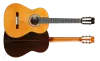
Guitarra flamenca de ciprés macizo y mango de cedro con refuerzo de ébano.


The tocaores use the techniques of alzapúa, picado, rasgueado and trémolo. The 'rasgueo' or strumming can be done using 5, 4 o 3 fingers, this last one was created by the master Sabicas. The use of hte thumbs is also very distinctive of the flamenco touch. The guitar players place the thumb in the harmonic lid and the index and middle fingers on the cords that are over the ones that are being played. This way the performer reaches a greater power and sonority than the classic guitarrist. Also the middle finger is placed in the pickguard to reach a better precission and strength when playing the cords. Besides, the use of the pickguard as a percussion element gives strength to the flamenco interpretation.


Some flamenco songs are interpreted without instruments, without guitar. Depending on the kind of performance its called in different ways:


  • Airy touch: lively, rythmic, cheerful, brilliant sonority, almost metallic.
  • Gipsy or flamenco touch: deep and with a pinch, uses preferably the bordones and musical setbacks
  • Pastueño: slow and relaxed
  • Sober touch: without ornaments or superflous brags
  • Virtuous: with exceptional technique domain, it can risk falling into excessive force 
  • Short touch: poor in technique and expressive resources 
  • Cold touch: lack of depth and pinch


Some important guitarrists have been Antonio de Torres Jurad, considered the guitar's father, Manuel Ramírez de Galarreta, el Gran Ramírez and its pupil Santos Hernández. He, at the same time, built several guitars for the Sabicas master, main promoter of the flamenco internalization. Others that stand out too are Domingo Esteso, Modesto Borreguero or the Conde brothers, Faustino y Julio, nieces of the first one. And, of course, it have to be mention the genius Paco de Lucía, considered one of the main modern flamenco figures, since he is credited with the origin of the reform of the musical scene thanks to the fussion of new rythms like jazz, bossa nova and classical music.


Paco de Lucía fue el precursor de las fusiones flamencas con otros estilos musicales.


Read more →
Flamenco flair activities for this summer

Flamenco flair activities for this summer

With the arrival of summer come the vacations and the free time. What better idea than to take advantage of it by participating in all sorts of activities with some flamenco flair. Here are some of the things that you can spend your summer doing:


Intensive courses and flamenco lessons: 

This is the most obvious one but it is also the easiest due to the fact that almost any academy or studio offers, during the summer break, a wide variety of classes and courses. In fact, if you look closer you can find some imparted by some of the most recognized and prestigious choreographers and dancers with whom you will be able to learn about professional flamenco dancing and improve your technique while expanding your knowledge. Even if you are a begginer or flamenco dance is something you always wanted to do but never found the time to do it, now is the moment for it. Sign yourself up and try some classes while having a great time meeting new people. This classes are also for kids and adults of different levels you have no excuse. And if you need any skirts, dance shoes or any other accesory you can find a great selection in our web that will meet your requirements.


Some examples of courses:


  • Intensive courses: The intensive classes are a good way to enjoy your free time learning from some of the best flamenco artists. There is a big variety of courses focused in learning how to dance bulerías, spanish dance, how to play flamenco box or guitar, etc.


In our web you will find flamenco dresses and accesories for your classes


Flamenco camps:

Related to what was said before, there are summer camps that offer training in different techniques and flamenco styles. Kids and adults of all levels can learn and improve while chatting, playing games, and doing all sort of fun activities with other people. What better way to spend the summer than dancing.


  • Flamenco Workshop Miraflores 2017 in MadridYou could go to classes with some of the best professionals and the camp includes other activities like flamenco movies nights, visits to Miraflores and Madrid, hiking, horseriding, routes, climbing and spanish classes for foreigners.

  • II International Flamenco CampOrganized by the Andalucía Flamenco School in Iruela (Jaén), this camp offers as well side activities like tastings, visits, parades and awards ceremony, and, of course, an exhibition show created by teachers and students of the camp.

  • Flamenco Camp Malaga 2017: This one in particular is going to take place in Malaga and offers a complete inmersive experience of the flamenco world. 


Camps like the one in Miraflores are a good way to learn and have fun


Festivals:

If you are one of those that likes flamenco dance but prefers to watch it, then festivals and concerts are maybe your thing. Here are some of the most interesting ideas for this summer if you are planning to go to at least one:


  • Flamenco On Fire festival: This festival, which already is in its fourth edition, has become one of the most key events of the calendar for flamenco lovers. From the 22nd to the 27th of August, the northern city of Pamplona welcomes one more year an event that will receive a big number of incredible artists. This year people like Cañizares, Martirio, Pedro 'El Granaíno', Miguel Ángel Cortés, Carmen Linares, Arcángel, Jon Losada y Antonio Losada, Tomasito, Antonio Carmona o Miguel Poveda will be performing in the main auditorium of Baluarte, which will host five big shows, as well as Sala Zentral, that will include a big concert, and the Tres Reyes Hotel that will have a tablao in which the 'Night Cicle' will have place with six first class acts.


Flamenco On Fire festival has become a key event.


Flamenco parties:


The summer always is a perfect time for parties with friends and family, to enjoy dancing, eating, drinking and having fun. Here are some ideas if you want to host a thematic flamenco party yourself:


  • Remember to decorate the place in which you are going to celebrate the party so it has a flamenco touch. You can use flowers, lanterns, posters or even big personalized fans for the walls. You decide how to put it, just remember in flamenco parties everything is not enough.

  • Also, do not forget the music. There is a wide variety of flamenco singers that your guests will enjoy but mix it with modern singers too so the young ones feel also included.

  • With these high temperatures we should remember to use our fans too. It  is a really important accesory to have in order to survive the heat, and besides, it also is very versatile since you can use it for decorating walls, tables or even as a party favor for your guests. You can personalized them to make it more fun or everyone can use the same if you are celebrating a bachelorette party.

  • Last but not least, remember to prepare typical flamenco dishes to give the party a bigger flamenco flair. For example, you can cook andalusian gazpacho, very nutritious, fresh an easy to make and pair it with a stew, don't forget the seafood and the fried fish. And top it with a drink like rebujito, a classic summer and fresh beverage very common in Andalucía. Your guests will love it.


The flamenco dresses and skirts are essential for a folkloric flair for your party.


Read more →
And...the end of the classes arrived!

And...the end of the classes arrived!

Summer is here and with it comes the end of year for most dance schools. As always is time to prepare everything so everything comes out perfectly. In Flamencoexport we have a wide variety of products that could be useful if you are a student in the show that each year every dance academy or school prepares in this time of the year. Also, if you are a teacher and you are looking for clothes and accesories for your choreography to be spectacular, in our web you will find what you are searching for. Here we will show you a list of some of the most useful and comfortable products, perfect for ocassions like this:


  • Fans


We have a large selection of fans of all kinds and sizes, for adults and kids, that will make your choreography more spectacular and colourful. You can find them with all sorts of styles, elegants, with pollka dots and prints, in diferent colours, and, if you want to be original you can buy our special DIY fans


  • Castanets


Another essential accesory to complement the dances are the castanets. They have a vibrant sound and in our web you can find them in different materials, specially made for all sorts of learning levels, sizes and several prices. Take advantage of them and make a party out of your dance using this beautiful and harmonious musical instrument.


Flamenco skirts


Skirts are one of the most important elements of a flamenco dance. In our web you can find them in all sorts of colours, sizes, for kids and adults, etc. We have a wide selection, all of them artisanal and made with the highest quality materials. Besides, they can be custom made if needed. 


Flamenco shoes


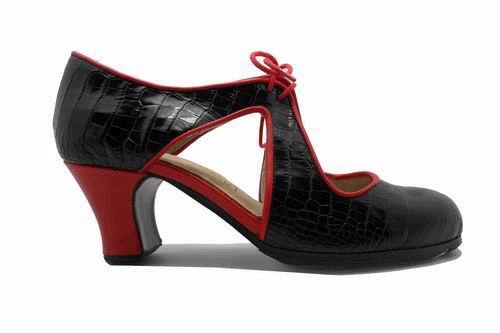
Every person that is involved in flamenco needs good shoes, the most important part of any dance. We offer a great variety of them for women and men, made in several materials, with or without nails, specifically made for the different learning levels of the students, and most important, comfortable and practical. In our page we sell all sorts of shoes from highly recognized and qualified brands, who make this footwear with the highest quality standards. And, of course, we also provide replacement nails to change them when needed.


  • Flamenco dance suits


For those who are looking for the full outfit, in Flamencoexport we have also all sorts of flamenco dance suits, beautiful, economic, useful and perfect for any end of the year show. If you want your students to dress like professionals, this can be a really good option. 


  • Accesories


To complete the look, the accesories are an important part of it all. They bring colour, brightness and makes the dancers to stand out, be part of a group but at the same time show their own personality.


Read more →
Living the Pilgrimage of el Rocío de Huelva

Living the Pilgrimage of el Rocío de Huelva

The pilgrimage of El Rocío of this year, that started yesterday, is a good ocassion to buy some beautiful flamenca dresses or campero suits, and be a part of the festive environment that happens during this days in Huelva. For everyone that is eager to experience what transpires these days during this popular fiesta, there is still time, the most important days are the 4th and 5th of june in the village of Almonte. Of course, you can find in our website a huge assortment of campero suits, dresses, blouses, pants and accesories as well as all of the necessary accesories and to dress traditionally and be part of this event. As basic tips for those who have the intention to go to the pilgrimage is good to remember a few things such as not carry to much weight, use light clothes, don't forget your camera and specially protect yourself from the sun.  


As a little background about this fiesta is always good to remember that the pilgrimage is a religious and very popular celebration in honor of la Virgen del Rocío, also known as the Blanca Paloma in Almonte, Huelva. Its celebrated the weekend of the Pentecost Sunday and includes a walk to the hermitage were her image is located. Usually the fiesta lasts a week even though the big days are the ones of the weekend, moment were the fervour of the parishioner is at its peak.


In this fiesta its celebrated the descent of the Holy Spirit and the start of the Church activity, and during these days, the village of Almonte, that normally has around 22.000 residents becomes the third city of Spain in number of people. The pilgrimage starts on Saturday with the Santo Rosario, and ends when the image of the virgin goes back inside the hermitage on Monday morning. El Rocío attracts every year a hundred of fraternities of each of the closest areas like Cádiz, Huelva y Sevilla. The pilgrims cross by foot and some times by boat, the marshlands of the Guadalquivir delta, to arrive to this fiesta, in the limit of the Natural Park of Doñana.


The procession starts when the pilgrims walk the road to the village, dressed with flamenco suits, by foot, by horse or in carriages pulled by donkeys or oxen. Through this week people sing during the day, and at night they camp around a bonfire, and thats when the fiesta starts and everyone sings, dances and shares food and wine. 


One of the most important moments of this fiesta happens at midnight, during Pentecostés Monday's dawn, when starts the Santo Rosario pray. Then, after the parade of the fraternities insignias in front of the hermitage, it happens the so called Jump to the Fence. A massive entry of the devoted inside the Blanca Paloma's temple, to take her out in procession. The virgin, in the street, over the shoulders of those who have had the honour of arriving where she was, is walked around between the parishioners. During the procession the bells doesn't stop to ring as the pilgrims cheer the virgin with rose petals.


This is a week full of passion, devotion, tradition, feelings and amusement. The pilgrimage of el Rocío is one of the most famous and massive ones that exists and constitutes the emblematic expression of the popular religiosity of Andalucía. That way, for those of you that are going to experience it for the fist time just enjoy it and let yourself loose.


Read more →
Flamenco drum box contributions

Flamenco drum box contributions

The box drum is a musical instrument of afroperuvian origins that has become popular all over the world thanks to flamenco, modern jazz and afro-latin-caribbean music. They is data about the first box drums existing in Peru in the XIX century, but until 2001 it was not recognized as National Cultural Heritage.


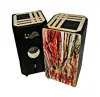
Flamenco Drum Box by Manuel Cortés, model Sky Blue


The instrument was born in the central and north peruvian coast. The box drum was created by africans that were brought into the country as slaves during the spanish colonization. This people saw the wooden boxes, used to move goods, as a great percussion instrument and they started using them for their sacred rituals and artistic manifestations. For this same reason, the drums were prohibited by the Catholic Church because they thought the instrument was pagan, and during the Viceroyalty of Peru was also banned to prevent the black people to communicate with each other on the distance. All of the box drums found were burnt.


The first references about the box drum being used as a musical instrument started to appear in 1840. The artist normally sits on top of it and has the drum box in between the legs. This posture helps them feeling the rythm while striking the instrument with the palms or fingertips to create sounds. The most modern version has, also, three extra screws that help to adjust the tone, and,  sometimes in order to enrich the music some small metal objects are put inside the box. In Spain, for example, the flamenco box includes three or four metallic cords to add resonance.


Flamenco Drum Box by Mario Cortés, World Soul


In its originis the peruvian box drum was used in traditional dances from the centre and north of Peru. But slowly its influence expanded to a global stage. The main reason why the box drum arrived to Spain and more specifically to the flamenco community was the famous andalusian musician Paco de Lucía. After a tour in 1977 through Latin America, he decided to take the peruvian drum box back with him and started using it in his shows. Since then and after 25 years, it has become an irreplaceable element in our culture and has become the reason of the birth of a lot of new percussionists in the contemporary flamenco. Such a great integration in the local culture is related to the fact that the box drum is just in between the flamenco claps and the foot stomping. This is also why the now called flamenco or spanish drum box has suffered several variations like the use of cords inside of it, or the change of the way to fix the acoustic lid to the box. 


Flamenco Drum Box by Mario Cortés, model Black&White


Also, as the times moves the box drum has experienced influences in the ways it can be played. As it expanded globally, not just percussionists but also drummers have become close to it and this has allowed the introduction of new tools, like drumsticks, specially metal and plastic brushes, and even a pedal, which transforms it in indirect percussion and makes it almost a pedal bass drum, only the flamenco drum box has the limitation of the initial position. In this sense, in 2008 the italian Ovidio Venturoso created a system with a pedal to play this instrument with the hands and the foot, but without altering the traditional position of the musician.


Another interesting idea has been created by the sevillian artist, Daniel Galiano, who, after arriving to the airport and seeing his drum box broken, invented a foldable one. This invention, easily transportable since it can fit in a suitcase or a backpack, and whose sound doesn't change in quality, is something that was never brought up before.

Read more →
Flamenco Export Help
Order status Customer Service

(+34) 91 542 72 51.
We’re open from Monday – Friday 10h-13:30h / 17:00-20:00h and Saturdays 10h-13:30h (GMT + 1).

 
In 2024, we will be closed for holidays on the 1st and 6th January, 28th, 29th, and 30th March, 1st, 2nd, and 15th May, 25th July, 15th August, 12th October, 1st and 9th November, 6th, 7th, and 25th December.
 
Our shop is located in Calle Campomanes nº 4, Madrid 28013 España (Ópera Metro Station)